Menopause Nutritionist in Brisbane
Clinical nutrition for perimenopause and menopause, built from your own blood chemistry.
- 50+ five-star reviews
- ANTA accredited
- In-clinic in Wilston, or online across Australia and New Zealand
- 40-minute session · $100 credited toward a new MB program

Visit The Clinic
If your body has stopped responding, you are not doing it wrong.
Sharon consults in person at the Metabolic Health Hub in Wilston, just north of Brisbane's CBD - easy to reach from across the inner-north.
If you’re in your forties or fifties and your body has stopped responding the way it used to, you are not imagining it and you are not doing it wrong.
These are not separate problems, and they are not a character failing. They are what happens when oestrogen declines and your metabolism is left working under rules it wasn’t built for.
I’m Sharon Carius, a clinical nutritionist in Wilston, Brisbane. I work almost entirely with women going through this transition - and the approach I take starts with your bloodwork rather than with a meal plan.
Is this you?
Do I need a menopause nutritionist?
A menopause nutritionist is worth seeing when the symptoms are metabolic rather than purely hormonal - when weight, energy, sleep and cravings have changed and your GP has told you your bloods are normal. Most women come to me when:
- Weight is accumulating around the middle and the approach that used to work has stopped working entirely.
- Energy has collapsed in a way that doesn’t respond to more sleep or more caffeine.
- Their GP has said the bloodwork is normal while they feel anything but.
- They’re on HRT and it’s helped the symptoms but not the weight or the energy.
- They want to avoid medication and want to know what nutrition can realistically do first.
What a clinical nutritionist adds that general advice can’t is specificity: testing which of your metabolic markers are actually out of range, and building the plan from that rather than from what works for women in general.
The mechanism
Why menopause changes what your body needs
Insulin sensitivity falls
As oestrogen falls, insulin sensitivity falls with it. Your cells take up glucose less efficiently, your pancreas compensates with more insulin, and because insulin is a storage hormone, your body holds fat rather than releasing it - particularly around the abdomen.
Muscle gets harder to keep
At the same time, muscle becomes harder to maintain, which lowers the energy you burn at rest.
Inflammation rises
Oestrogen’s loss as an anti-inflammatory agent raises inflammatory markers, which interferes with hormonal signalling and makes everything harder.
This is why eating less and exercising more so often backfires at this stage of life. Cutting calories further raises cortisol and lowers thyroid output. Adding high-intensity training raises cortisol again. Both push your body harder into the state you’re trying to get out of.
I’ve written about the mechanism in detail here →
My approach
What I do differently
Most menopause nutrition advice is population advice: eat more protein, cut the sugar, manage your stress. It isn't wrong. It just isn't specific to you, and at this stage of life the specifics are what determine whether anything actually shifts.
Standard laboratory ranges
Built to detect disease
The ranges your GP uses.
Functional optimal ranges
Show where you’re drifting
Identify where your biochemistry is heading before it becomes a diagnosis.
Two women the same age with the same symptoms can need genuinely different plans - different carbohydrates, different protein amounts, different meal timing - because their metabolisms are not the same. Handing them both the same meal plan is why so much of what you've already tried worked for a while and then stopped.
So I don't start with a plan. I start with your history: what's changed, when it changed, what you've already tried, where you are with HRT or medication, and what your days actually look like. The plan comes after that, and it's built for you rather than adapted from a template.
You don't have to commit to a program to start
Not everyone who comes to me needs twelve weeks of clinical support, and I'd rather tell you that than sell it to you. Some women need the structure and the accountability. Others need to understand the mechanism and then get on with it themselves.
That's why there's a way in at every level — a fortnight you can start today on your own, a single conversation to work out what's going on, and a full programme if that's what your situation warrants.
What we work on
The symptoms we get to the cause of
Weight that won’t shift
Particularly around the middle, and particularly when nothing has changed in how you eat.
Energy and the 3am waking
Blood sugar instability overnight is a common and treatable driver.
Brain fog
How your brain uses glucose changes as oestrogen falls.
Bloating and digestive change
Fluctuating hormones alter gut motility and the microbiome.
Hot flushes
Nutrition won’t replace HRT, but blood sugar stability measurably affects frequency for many women.
Joint aches and inflammation
Often dismissed as ageing, often an inflammatory marker worth testing.
Coming off, or going onto, HRT or a GLP-1
Making sure the nutrition underneath is working either way.
How it works
Three steps, one clear answer.
Visit The Clinic
Visiting the clinic in Wilston
I see clients in person at the Metabolic Health Hub in Wilston, five kilometres north of the Brisbane CBD.
- WNutrition — Metabolic Health HubLevel 1, 102 Kedron Brook Road Wilston QLD 4051
- Reception0431 967 056
- Emailinfo@wnutrition.com.au
The clinic is a short drive from these suburbs, with parking on site:
Albion, Windsor, Grange, Newmarket, Lutwyche, Kedron, Alderley, Ashgrove, Stafford, Clayfield, Herston, Red Hill, Paddington and surrounding inner-north Brisbane suburbs.
If you’re further afield, or you’d simply rather not travel, consultations are available online across Australia and New Zealand. The process is identical — the blood work is done through a local collection centre.
Why women choose Sharon
Ten years of working with women in midlife
#1
Metabolic Balance® practitioner, ANZ 2025
500+
Clients transformed
10
Years in clinical practice
30+
Blood markers analysed
What Brisbane women say
Questions
Frequently asked questions
Do I need a nutritionist or a dietitian for menopause?
Both are qualified to help, and the honest answer is that it depends on what you need. Accredited Practising Dietitians work within the medical system and can be accessed through a GP referral with a Medicare rebate, which matters if you have a diagnosed condition being clinically managed. Clinical nutritionists like me work in more depth on functional testing and personalised biochemistry, and are not Medicare rebateable. If you want your plan built from your own blood markers rather than from general guidelines, that’s the work I do. If you want a Medicare-rebated service, you want an APD, and I’ll say so. Read the full comparison →
Can nutrition help menopause symptoms, or do I need HRT?
They do different jobs and they are not alternatives. HRT replaces hormones and is often very effective for symptoms like hot flushes and mood. It is not a weight-loss treatment, and many women find their symptoms improve on HRT while the weight and energy do not. Nutrition addresses the metabolic side — insulin sensitivity, inflammation, muscle maintenance. For some women one is enough; for many, the two together work better than either alone. Whether HRT is right for you is a conversation for your doctor.
Will this work if I’m already on HRT?
Yes, and it often makes HRT more effective. When your metabolism is working properly your body uses the hormones you’re taking more efficiently, which frequently brings a further reduction in symptoms like brain fog and bloating.
How much does it cost to see a menopause nutritionist in Brisbane?
The first step is a 40-minute Health Strategy Session at $150, with $100 credited back if you go on to join a program. Program pricing depends on what suits you and we discuss it in that session - I don’t quote a program before understanding whether you need one.
Do you offer online consultations?
Yes, across Australia and New Zealand. The process is the same as in clinic, with blood work done through a collection centre near you.
How long before I notice a difference?
Most women notice changes in energy and bloating within the first fortnight. Genuine metabolic change - the kind that holds - is a twelve-week process, because that’s how long it takes for blood chemistry to stabilise and for your body to come out of a prolonged stress response.
Can I see you if I’m post-menopausal, not perimenopausal?
Yes. The metabolic changes don’t reverse once periods stop, and in some respects insulin resistance becomes more entrenched. The approach is the same; the markers we prioritise differ.
Where To START
Find your path to metabolic health.
Not sure where to start? Pick the one that sounds most like you today.
From a simple first step to a fully personalised program — start wherever feels right for you.
Not ready to BOOK
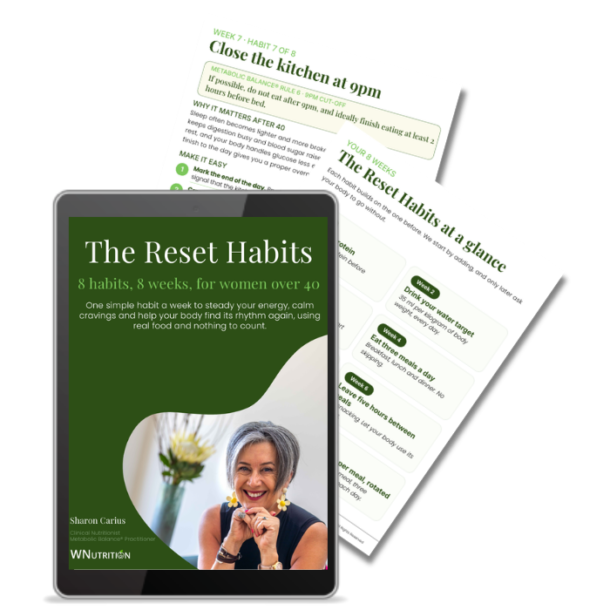
14-Day Metabolic Kickstart
Build the foundation first
Fourteen days of structure to build the habits everything else rests on - the same foundation many of my Metabolic Balance® clients put in place before their personalised plan begins.
- Steadier blood sugar through the day
- Fewer cravings, particularly in the afternoon
- Better digestion and less bloating
- Energy that does not collapse at 3pm
Self-paced · Begin today
Ready to find out what’s going on
40-Minute Health Strategy Session
One conversation with Sharon
The most thorough way to understand what is actually happening with your body - and whether a personalised plan is genuinely the right next step for you.
- What’s actually driving your symptoms
- Which markers are worth testing
- Whether a personalised plan suits you
- A clear path forward, whichever direction that points
$150 · 40 minutes
$100 credited back when you join a MB program
In-clinic in Wilston, or online Australia-wide