A 7-Day Diet Plan for Weight Loss: What Actually Works (and Why Most Plans Miss the Point)

Sharon Carius
Clinical Nutritionist, Metabolic Balance® Practitioner
If you have searched "7-day diet plan for weight loss," you have already seen hundreds of versions of the same thing — a table of meals, a calorie target, a shopping list, and the promise that this time it will be different.
I want to offer you something more useful than that. I'm Sharon Carius, a Clinical Nutritionist and Australia and New Zealand's #1 Metabolic Balance® practitioner for 2025. I work primarily with women in their 40s and 50s who are doing everything right and still not getting results. What I'm going to share with you is grounded in clinical practice, not wellness culture.
Let's start with the conversation I have with almost every new client.
Why "Nothing Works Anymore" Is Not in Your Head
The most common thing I hear from women who come to see me is some version of: "I'm doing everything I used to do, eating well, exercising, being consistent - and nothing is shifting."
They are not imagining it. And it is not a willpower problem.
What has changed is their biology. As women move through their 40s and into perimenopause and beyond, oestrogen and progesterone levels shift significantly. These hormones don't just govern your cycle - they influence how your body manages blood sugar, stores fat, and responds to food. When they change, the rules change with them.
Before any diet plan will make a meaningful difference, a woman needs to understand one thing: her metabolism may be dysregulated, and no amount of discipline will override dysregulated physiology.
You cannot white-knuckle your way past a hormonal and metabolic mismatch. The starting point is not willpower. It is understanding what your body actually needs.
Why Diets Work and Then Stop Working
Most popular diets - keto, 5:2, low calorie, whatever is trending right now - do produce results initially. That is not a coincidence. They all share a common mechanism: they reduce blood sugar spikes and lower insulin, at least temporarily.
But here is the clinical reality. Those diets do not fix the underlying metabolic issue. They manage the symptoms of it. The moment you stop - and almost everyone stops eventually, because these diets are not sustainable - your metabolism has not changed. Your body goes straight back to what it was doing before. The weight returns, often with interest, because your metabolic rate has adapted downward in response to restriction.
This is not a failure of character. It is the predictable outcome of treating a metabolic regulation problem with a temporary dietary intervention.
What most plans miss is that sustainable fat loss requires the metabolism itself to be repaired - not just bypassed.
What a 7-Day Plan Can Actually Do
I want to be honest with you here. Seven days is not enough to undo years of metabolic imbalance. It is not going to resolve insulin resistance that has been building for a decade. Anyone who tells you otherwise is overpromising.
What seven days can do is show you what is possible.
When you structure your eating in a way that supports blood sugar regulation, reduces insulin spikes, and gives your body the right macronutrient balance, most women notice meaningful changes within days - not weeks. Cravings drop. Energy stabilises. The constant pull toward sugar or carbohydrates diminishes. Sleep often improves. That 3pm crash that feels inevitable starts to feel optional.
That is not magic. That is your physiology responding to the right inputs.
The goal of a 7-day reset is not transformation. It is proof of concept - a demonstration that your body can feel different, and that the path forward is not more restriction but better structure.
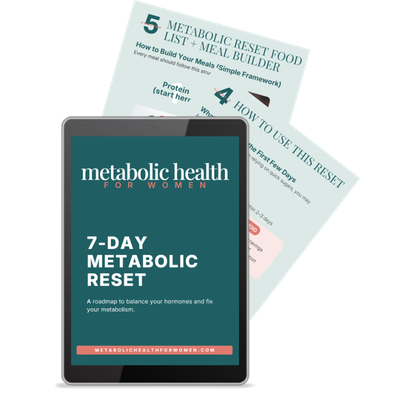
If you want to put this into practice straight away, I've put together a free 7-Day Metabolic Reset guide that walks you through exactly this — the five non-negotiable rules, the metabolic food list, and a day-by-day roadmap for moving from blood sugar instability to metabolic control. You can download it free at metabolichealthforwomen.com/metabolic-reset.
The Problem With Generic Meal Plans
Most 7-day diet plans online make the same fundamental error: they prescribe specific foods as though one set of foods is right for every body.
It is not.
Your metabolism is shaped by your hormone profile, your level of insulin sensitivity, your inflammatory load, your gut health, your stress response, and your individual biochemistry. What works exceptionally well for one woman may do almost nothing for another - not because one of them is doing it wrong, but because their bodies are genuinely different.
This is why I do not hand clients a meal plan and tell them to follow it. Instead, I teach them a framework - a set of principles about how food acts in the body - and then help them identify which foods work best for their specific biochemistry. The goal is to give women tools they can use for life, not a plan they follow for a fortnight and then abandon.
That said, there are habits and structures that benefit almost every woman, and a 7-day reset built around those principles is a genuinely useful starting point.
The 5 Principles Behind an Effective 7-Day Reset
Eat three structured meals a day
Stop grazing. Constant snacking keeps insulin elevated throughout the day, which prevents fat burning and increases hunger over time. Spacing your meals - ideally four to six hours apart - allows insulin levels to come down between eating occasions. This is one of the most impactful changes most women can make, and it costs nothing.
Prioritise protein at every meal
Protein is not optional. It is essential for satiety, blood sugar stability, and maintaining the muscle mass that keeps your metabolism functioning. Every meal should contain a clear protein source - eggs, chicken, fish, Greek yoghurt, legumes, tofu. Aim for a palm-sized portion as a minimum.
Inadequate protein is one of the most common reasons women feel constantly hungry despite eating regularly. The body interprets low protein as a signal to keep searching for food.
Never eat carbohydrates alone
Carbohydrates consumed on their own cause rapid blood sugar spikes, followed by the sharp drop that triggers cravings and energy crashes. Always pair carbohydrates with protein, healthy fat, and fibre. This slows glucose absorption and reduces the insulin demand on your body.
This single habit eliminates a significant proportion of the cravings most women experience within the first two to three days of applying it consistently.
Eat at consistent times
Irregular eating patterns disrupt blood sugar regulation, hunger hormones, and cortisol rhythms. Your body responds well to predictability. Eating at roughly the same times each day - and avoiding late-night eating - supports the hormonal rhythm your metabolism depends on.
Build meals around whole, unprocessed foods
Highly processed foods are engineered to be rapidly absorbed, easy to overconsume, and low in satiety. They are not designed with your metabolism in mind. Focus on whole proteins, non-starchy vegetables filling half your plate, healthy fats for satiety and hormone production, and minimally processed carbohydrates when you include them.
A Simple 7-Day Structure
Rather than prescribing specific meals, here is how to think about the week in phases.
Days 1–2: Establish the glucose baseline
The focus is stopping blood sugar spikes. Eat within 60 to 90 minutes of waking. Hit a minimum of 25 to 30 grams of protein at each meal. Eliminate naked carbohydrates entirely. Most women notice cravings dropping noticeably by the end of day two.
Days 3–4: Flood the body with nutrients
Add leafy greens to every meal. Include red meat or iron-rich protein - this is particularly important for women, who are frequently under-consuming iron. Add eggs daily for their choline and micronutrient content. Increase water intake significantly; aim for 35ml per kilogram of body weight. Energy typically lifts and brain fog begins to clear during this phase.
Day 5: Cool the inflammation
Remove ultra-processed foods entirely. Add anti-inflammatory fats - olive oil, avocado, fatty fish. Many women notice a reduction in bloating and fluid retention by the end of day five.
Day 6: Support hormone rhythm
Focus on cortisol and sleep. Get morning sunlight - this is not optional, it is one of the most powerful tools for regulating your cortisol rhythm and downstream hormone function. Avoid caffeine after midday. Make dinner your most protein-rich meal of the day. Better sleep directly improves insulin sensitivity.
Day 7: The baseline audit
Reflect on what has changed. How are your hunger levels different from seven days ago? Has your energy been more consistent? Have cravings reduced? Are you relying less on snacks? These are the signals that your metabolism is responding to the right inputs.
What a Real Client Experienced
One of my clients came to me at 50, twenty kilograms overweight and, in her own words, lacking vitality in all areas of life. She had been trying to research her way out of the problem and found herself overwhelmed by the volume of conflicting information available. What drew her to work with me was the science-backed approach - not another trend, but an explanation of how food actually acts in the body.
What I taught her was not a diet. It was a framework - eight principles for how to eat in a way that supports her specific body, for life. No foods labelled good or bad. No calorie counting. Just a clear understanding of how her choices were affecting her metabolism, and tools she could use permanently.
Nearly twelve months later, she had lost 16 kilograms sustainably, dropped two dress sizes, and described feeling like herself again for the first time in years. She told me it was the best she had felt in years - and that she was actually sad not to need to see me regularly anymore.
That last part matters. The goal is never dependency. The goal is that you understand your body well enough to not need me.
What to Expect in the First Few Days
When you shift away from relying on quick sugars, your body will often push back initially. Cravings may intensify briefly. You might feel mildly fatigued, get a headache, or feel irritable. This is a normal physiological response as your blood sugar begins to stabilise.
It typically improves within two to three days.
The most common mistakes that derail a reset are skipping meals (which increases cortisol and drives cravings), not eating enough protein, undereating overall which slows metabolic adaptation, and overcomplicating meals to the point where you abandon the whole plan. Keep it simple. A meal does not need to be elaborate. It needs to contain protein, fibre, and fat. If it does, you are on track.
Seven Days Is a Starting Point, Not a Solution
If you complete a 7-day reset and feel meaningfully better, that is real progress. Your blood sugar has begun to stabilise. Your insulin response is improving. Your body has shown you what is possible.
But it has not solved the underlying issue.
If you are dealing with stubborn weight gain, ongoing fatigue, hormonal symptoms, insulin resistance, or PCOS, these are not conditions that resolve in a week. They are driven by underlying metabolic dysfunction that requires the right structure, the right level of personalisation, and the right progression over time.
This is where generic plans consistently fall short. What works for one woman's metabolism may do very little for another. Long-term, sustainable change requires a plan built around your specific biochemistry - your hormone profile, your blood markers, your individual metabolic state.
Where to Go After the Reset
If you have completed a 7-day reset and experienced what is possible, the next step is building on that foundation in a way that is specific to your body.
The program I use with clients is Metabolic Balance® - a clinically structured 12-week program built around your unique blood chemistry. It uses your specific blood markers to create a personalised nutrition plan that addresses the root cause of your symptoms, not just the surface effects. You can learn more about how it works at wnutrition.com.au/metabolic-balance.
For women dealing specifically with hormonal weight gain, fatigue, and perimenopausal symptoms, the Personalised Hormone and Weight Reset programme provides a structured path that combines metabolic nutrition with targeted hormonal support. Details are at wnutrition.com.au/hormone-weight-reset.
The most useful first step for most women is a 40-minute Health Strategy Session - a focused consultation where we review your symptoms, your history, and what your body actually needs. It costs $150, and $100 of that is credited toward any programme if you decide to go further. You can book at wnutrition.com.au/bookings.
A Final Word
You do not need more restriction. You do not need another diet. You need a structure that supports your metabolism, applied in a way that is right for your body.
Seven days is enough to show you that a different way of feeling is available to you. What you do with that information is up to you - but if you are tired of plans that work briefly and then fail, it may be time to address the reason they keep failing.